
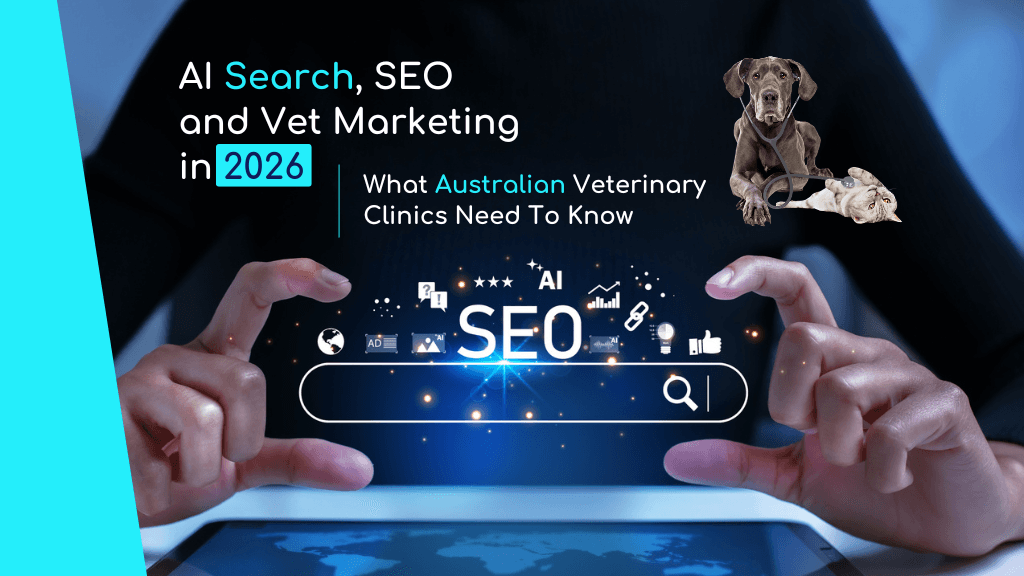
AI Search, SEO and Vet Marketing in 2026: What Australian Veterinary Clinics Need To Know
)
Pet owners are changing the way they search for veterinary advice.
For years, vet clinics have focused on showing up in Google through SEO, Google Business Profile, online reviews, local content and a well-structured website. All of that still matters. In fact, it matters more than ever.
The difference now is that pet owners are increasingly using AI tools and AI-assisted search to ask more detailed questions, compare local clinics and make decisions about who to trust with their pet’s care.
Instead of only searching for terms like “vet near me” or “dog vaccinations Brisbane”, pet owners are asking more specific questions, such as:
- “Which vet near me is good with anxious dogs?”
- “Does my cat need urgent care if they are limping?”
- “What should I do if my dog has itchy skin and keeps scratching?”
- “Which local vet offers dental checks and dental X-rays?”
- “Who is the best vet near me for senior pet care?”
This shift matters because AI tools need to clearly understand your clinic before they can recommend it.
To remain visible, protect your local rankings, and keep your appointment book full, your clinic's website can no longer act as a passive digital brochure. It needs to become an active, educational information hub that AI tools trust enough to recommend.
Why veterinary clinics need to pay attention
Australia is already a highly digital market. DataReportal’s Digital 2026 Australia report found that Australia had 26.2 million internet users at the end of 2025, with internet penetration at 97.1%. In simple terms, pet owners, as you know, are already online, but now they are using the internet more to find answers, compare clinics and decide where to book.
Google has also rolled out AI Mode in Australia, making AI-assisted search part of the Google experience for Australian users. This means people can now ask more complex, conversational questions and receive more complete AI-supported answers.
Australian research from Fifth Quadrant also shows that generative AI is increasingly being used for explanation, comparison and decision support, while traditional search engines are still commonly used for simpler searches.
For vet clinics, this is a big deal.
Pet owners are increasingly no longer search for veterinary care in a purely logical way. They are often worried, unsure, emotionally invested and looking for reassurance. If your website can answer their questions clearly and compassionately, you are in a much stronger position to be found, trusted and chosen.
SEO is not dead. It has become more connected.
There is a lot of noise around AI replacing search. But for veterinary clinics, the more useful way to think about it is this:
AI search is not replacing SEO. It is raising the standard.
Your clinic still needs strong local SEO, a well-structured website, clear service pages, Google Business Profile activity, reviews and consistent business details across the web.
The difference is that these elements now need to work together more effectively.
Your website can no longer be treated as a basic online brochure. It needs to become a helpful information hub for pet owners, Google and AI platforms.
A good veterinary website should clearly explain:
- Who you are
- Where your clinic is located
- What services do you offer
- What types of pets do you care for
- What makes your team credible and trustworthy
- What pet owners should expect
- When a pet owner should book an appointment
- When something may be urgent
- What common signs, symptoms and conditions mean
- What payment plans and options you have
- How can someone call, book or enquire
The better your website explains your clinic and your services, the easier it is for Google, AI tools and pet owners to understand when you are the right choice.
What the Duda report found
Duda analysed 858,457 small and medium business websites to understand how AI crawlers interact with SMB websites and whether AI visibility connects with real business outcomes.
| Duda finding | What this means for vet clinics |
|---|---|
| AI-crawled websites generated 3.2x more human traffic | Websites that AI systems can access and understand are also seeing stronger visitor activity. |
| AI-crawled websites generated 2.7x more form submissions | Better visibility is connected with more enquiries. |
| AI-crawled websites generated 2.5x more click-to-call events | AI-visible websites are more likely to drive phone calls. |
| AI-referred traffic increased 73% between March 2025 and February 2026 | AI search is already becoming a measurable traffic source. |
| ChatGPT drove 57% of measured AI-referred traffic | ChatGPT is already playing a major role in AI discovery. |
Source: Duda, 2026 AI Visibility for SMB Websites.
For veterinary clinics, the takeaway is simple: AI visibility is not just something to worry about in the future. It is already connected with website traffic, enquiries and calls.
What AI tools does a veterinary website need
AI tools are not magical mind readers. They rely on information they can access, interpret and trust.
For veterinary clinics, this means your website needs to be clear, detailed and well structured. AI tools and search engines need to understand your clinic name, location, services, team, reviews, booking options and answers to common pet owner questions.
If your website is thin, outdated or vague, AI tools have less useful information to work with. In that case, they may look to a competitor with stronger content, clearer service pages and more helpful answers.
This is why strong veterinary SEO foundations matter so much.
The vet SEO foundations that matter more than ever
The Duda report found that highly crawled websites shared several factors, including local schema, Google Business Profile information, reviews, booking functionality, FAQs, dynamic pages and blog content.
For veterinary clinics, these are the foundations worth reviewing.
| Area to review | Why it matters for vet clinics |
|---|---|
| Schema markup | Helps search engines and AI tools understand your clinic, services, locations and content. |
| Google Business Profile | Supports local visibility through services, opening hours, regular reviews, photos, posts and contact options. |
| NAP consistency | Your clinic name, address and phone number should exactly match across your website, Google profile, directories and social platforms. |
| Service pages | Gives each major veterinary service enough detail to be understood and recommended. |
| FAQs | Answers the natural-language questions pet owners are asking in Google and AI tools, with FAQs. |
| Reviews | Builds trust and gives potential clients confidence in your clinic. AI tools are now reading reviews to gain an understanding of what your clients say about your practice, and giving that insight into their searches. |
| Top Citations and directories for Vets | Reinforces your veterinary clinic details across reputable local and industry websites. |
| Blog and advice content | Helps answer pet owner questions and build topical authority. |
| Booking and contact options | Makes it easier for pet owners to take action when they are ready. |
| Social and GBP integration | Helps your helpful content travel further and point people back to your website. |
These are not new marketing ideas. But AI search is making them more important and more connected.
What this means for your veterinary marketing
Veterinary marketing in 2026 cannot rely on the odd social media post and a basic website.
Social media still has a place, but if your marketing activity only lives on Facebook or Instagram, you are missing out on a much bigger market and opportunity.
Pet owners are looking for answers across Google, AI tools, Google Business Profiles, review platforms, social media and websites. Your marketing needs to connect all of these touchpoints.
That means your social posts, Google Business Profile updates, blogs, service pages, FAQs and reviews should all support each other.
For example, if your clinic posts on Facebook about itchy skin in dogs, that post should ideally link back to a helpful website page or blog with more information.
That same topic could also be shared as a Google Business Profile update.
The website page could include FAQs about common causes, when to see a vet and what treatment may involve.
The service page could then link to your dermatology, consultations or pet health services.
That is integrated marketing. Everything works together, instead of each channel quietly doing its own thing in the corner.
Why forums, reviews and online conversations matter for vet clinics
Pet owners do not only look at your website when choosing a vet.
They may search Google, read reviews, ask in a local regional, pet interest, breed focused Facebook group, check Reddit, look at your Google Business Profile, scroll through your social posts or ask an AI tool for guidance.
This matters because AI search is influenced by more than just websites. Research shared by Neil Patel Digital suggests that AI tools draw strongly from user-generated content and forums, followed by blogs and news. Social media and reviews also play a role.
For vet clinics, this is especially important because pet care is emotional. Owners are not just looking for information. They are looking for reassurance.
Your website should still be the central hub, with your service pages, FAQs, pet health advice, team information and booking options. But your wider digital footprint also needs to support that trust.
This includes:
- Google reviews
- Facebook reviews and recommendations
- Local community groups and mentions
- Helpful social posts
- Google Business Profile updates
- Blog articles answering common pet owner questions
- Accurate clinic details across directories and listings
The smart approach is not to jump into every online discussion. That could get messy very quickly, especially when “Dr Google” has entered the chat.
Instead, use these conversations as insight.
If pet owners are asking about itchy dogs, dental disease, anxious pets, vomiting, senior pet care or vaccinations, those are topics your website should answer.
Then connect the dots. Post about the topic on social media, link back to your website for more information, and share the same advice through your Google Business Profile where appropriate.
This is how your marketing starts working as one system.
Your website provides the depth. Your social media creates awareness. Your Google Business Profile supports local search. Your reviews build trust. Your wider online presence reinforces your clinic’s credibility.
In 2026, the strongest vet clinics will not just have a nice-looking website. They will have a clear, helpful and consistent presence across the places pet owners are already searching.
Your Google Business Profile needs regular care, too
Your Google Business Profile is one of your most important local marketing assets.
It should not be something that gets updated once and then ignored.
For veterinary clinics, your Google Business Profile should include accurate and current information about:
- Clinic name
- Address
- Phone number
- Opening hours
- Holiday hours
- List all your Services
- Appointment links
- Photos
- Reviews
- Posts and updates
- Emergency or after-hours details, if relevant
- Common Questions
Your Google Business Profile should also reflect the helpful content you are already creating elsewhere.
If you publish a blog about summer heatstroke risks, add a related Google Business Profile post.
If you share a Facebook post about dental disease in pets, add a Google Business Profile update that points people to the full information on your website.
If you create a new service page about senior pet care, make sure that service is reflected properly on your profile.
This is where clinics often miss opportunities. They create useful content, but it only appears in one place. To get better results, your content needs to work harder across your website, Google profile and social media.
Social media should point people back to your website
Social media is valuable for staying visible, showing personality and keeping your clinic top of mind.
But social media alone is not enough.
A helpful social post is even more valuable when it links back to your website for more information.
For example:
- A Facebook post about puppy vaccinations can link to your puppy care or vaccination page.
- An Instagram post about dental health can direct people to your dental service page.
- A post about itchy dogs can link to a blog about skin allergies and when to book a vet visit.
- A senior pet health post can link to a dedicated senior wellness page.
- A cat behaviour post can link to a feline health article or service page.
- This helps turn social media attention into website traffic, enquiries and stronger search signals.
Think of social media as the signpost, and your website as the destination. If the signpost is interesting but does not lead anywhere useful, you are doing half the job. Also, backlink case studies, stories about your patients, to more information on the website (add the link in the first comment).
Build the most helpful veterinary website in your local area
Pet owners have endless questions.
Some are simple. Some are emotional. Some are urgent. Some are the same questions your reception team and vets answer every week.
That makes blog, FAQ and service content a major opportunity for veterinary clinics.
- Good content topics may include:
- Why is my dog scratching so much?
- How often should my cat have a dental check?
- What vaccinations does my puppy need?
- When is vomiting an emergency?
- How do I know if my pet is in pain?
- What are the signs of arthritis in older pets?
- Should my pet have blood tests before surgery?
- Why does my dog have bad breath?
- How can I help my anxious pet at the vet?
- When should I book a senior pet health check?
These are exactly the types of questions pet owners are asking online.
If your clinic is not answering them, someone else is, and they may be the clinic being found in your area.
To lead in your market, your website needs to become one of the most helpful veterinary resources in your local area.
That means constantly improving and expanding your content over time.
Service content needs to keep expanding
Many veterinary websites have a short list of services, but very little detail. That is no longer enough. If your clinic offers important services, they deserve their own well-built pages.
Depending on your clinic, this may include:
- Vaccinations
- Dental care
- Desexing
- Surgery
- Skin consultations
- Puppy and kitten care
- Senior pet health
- Diagnostics
- Advanced diagnostics, such as X-rays, ultrasound and blood testing
- Weight management
- Behaviour consultations
- Cat-friendly care
- End-of-life care
- Emergency care
Each page should help pet owners understand what the service is, when it may be needed, what to expect and how your clinic can help.
The goal is not to overwhelm people with medical detail. The goal is to provide clear, reassuring and useful information that helps them take the next step.
One of the strongest findings in the Duda report was that additional content increased AI crawler activity. Duda found that each additional blog post increased AI crawler visits by a median of 7%, while each additional website page increased visits by a median of 4%.
For veterinary clinics, this is a strong reminder that content depth matters.
A small, basic website gives search engines and AI tools limited information.
A well-built veterinary website with service pages, FAQs, advice articles, team information, location content and helpful internal links gives them much more to work with.
The clearer and more useful your content is, the easier it is for search engines, AI tools and pet owners to understand your clinic’s expertise.
Where should your clinic start?
You do not need to become an AI expert overnight.
The best place to start is with a practical audit of your current online presence.
Review your website structure, key service pages, FAQs, reviews, Google Business Profile, NAP consistency, social-to-website links, citations, competitor activity and ongoing content plan.
You do not need to fix everything at once, but you do need to know where the gaps are and which opportunities are most likely to make a difference.
Strategic audit list for veterinary clinics
| Priority | Area to review | Why it matters |
|---|---|---|
| High | Website structure | Helps pet owners, Google and AI tools understand your services. |
| High | Key service pages | Gives pet owners clear information and supports service-specific search. |
| High | Schema and technical SEO | Helps search engines interpret your clinic, services and locations. |
| High | Google Business Profile | Supports local visibility, reviews, photos, services and enquiries. |
| High | Reviews | Builds trust and supports local decision-making. |
| High | FAQs | Answers the questions pet owners are asking in AI and search. |
| Medium | Social-to-website links | Turns social interest into website traffic and stronger engagement. |
| Medium | Google Business Profile posts | Helps your useful content appear in local search spaces. |
| Medium | Citations and directories | Reinforces your clinic details across the web. |
| Medium | Blog and advice content | Builds authority and answers common pet owner questions. |
| Ongoing | Competitor review | Helps identify content gaps and local opportunities. |
| Ongoing | Strategy sessions | Keeps your marketing aligned with search and AI changes. |
Why the odd social post is not enough anymore
Many clinics are busy, and it is easy for marketing to become a quick Facebook Instagram post when someone has five minutes spare.
- The problem is that pet owners are searching across many places, not just scrolling social media.
- They are asking Google.
- They are reading reviews.
- They are checking your Google Business Profile.
- They are comparing clinic websites.
- They are asking AI tools for guidance.
- They are looking for reassurance before they call.
- That means your marketing needs to work as a system.
- A social post may create awareness, but your website needs to provide depth.
- Your Google Business Profile needs to support local visibility.
- Your reviews need to build trust.
- Your service pages need to explain what you offer.
- Your blogs need to answer common questions.
- Your technology needs to support search, performance and conversion.
When all of these elements work together, your marketing becomes much stronger.
Where Vet Marketing Services fits in
Vet Marketing Services has helped many veterinary practices build their online presence, improve their visibility and grow their clinics.
We understand that veterinary marketing is not just about getting clicks. It is about helping pet owners find the right care, building trust before they walk through the door and supporting clinics to become more visible in their local area.
In 2026, making marketing work means putting consistent energy into the right areas.
That includes:
- SEO strategy
- Website structure
- Service page content
- Blog and advice content
- Google Business Profile optimisation and regular interaction
- Review growth
- Local SEO
- Citation building and management
- Social media integration
- AI search readiness
- Competitor analysis
- Technology that supports growth
The clinics that lead their area are usually not the ones doing one thing well. They are the ones getting all the key pieces working together.
You do not need to manage all of this yourself
Veterinary teams are already busy caring for patients, supporting clients, managing staff and keeping the clinic running.
You do not need to become an SEO expert, AI search specialist, content strategist and Google Business Profile technician on top of everything else.
What matters is having a clear plan, strong foundations and consistent implementation.
Vet Marketing Services can help review where your clinic currently stands, identify the biggest gaps and prioritise the improvements most likely to make a difference.
This may include:
- Reviewing your website and SEO foundations
- Expanding your service content
- Creating helpful blog and FAQ content
- Improving your Google Business Profile
- Building a stronger review strategy
- Checking citations and NAP consistency
- Connecting social content back to your website
- Reviewing competitor activity
- Creating an integrated marketing plan
- Preparing your clinic for AI-assisted search
If you would like us to take care of a fair chunk of this for you, talk to Vet Marketing Services about how we can support your clinic.
The final takeaway for veterinary clinics
AI search is not replacing veterinary SEO. It is raising the bar.
Pet owners are looking for answers online, and they are becoming more comfortable using AI tools, Google and other platforms to compare their options.
To stay visible and competitive, your clinic needs more than the occasional social post.
You need a strong website, clear service content, helpful FAQs, consistent reviews, an active Google Business Profile, accurate local listings and a marketing strategy that connects everything together.
The clinics that succeed will be the ones that make it easy for pet owners, search engines and AI tools to understand who they are, what they do and why they can be trusted.
If it has been a while since your clinic reviewed its online presence, now is the time. A practical strategy session can help identify what is working, what is missing and where your biggest opportunities are for 2026 and beyond.
| Tags:ConvertStreamlineSEO |