
SEO, AEO and GEO: What Do They Mean for Veterinary Practices?
)
For many years, improving a veterinary practice’s online visibility largely meant focusing on Search Engine Optimisation, better known as SEO.
The objective was reasonably straightforward: help the practice appear prominently in Google when local pet owners searched for terms such as “vet near me”, “emergency vet”, “puppy vaccinations” or “cat dental care”.
SEO remains important. However, the way people research veterinary services, pet health concerns and treatment options is rapidly changing.
Pet owners are no longer relying solely on a list of traditional Google search results. They may also use Google Maps, online reviews, AI Overviews, featured answers or platforms such as ChatGPT to research a concern, compare providers and decide which veterinary practice to contact.
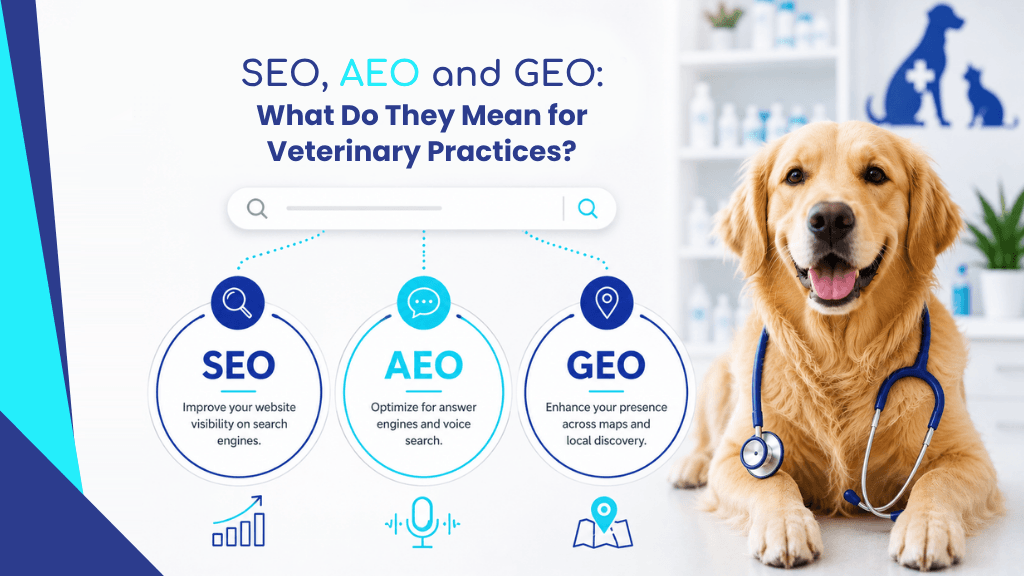
As search behaviour changes, three terms are becoming increasingly common: SEO, AEO and GEO.
So, what do they mean, and what should veterinary practices be doing differently?
What Is SEO?
SEO stands for Search Engine Optimisation.
It focuses on helping your website appear more prominently in traditional search engine results.
For veterinary practices, SEO can include:
- Ensuring Google can find and index your website
- Creating strong pages for your important veterinary services
- Improving page titles, headings and website structure
- Strengthening local relevance
- Optimising your Google Business Profile
- Improving mobile usability and website performance
- Building trust through reviews, links and accurate online listings
- Publishing helpful, original content
- Connecting articles and FAQs with relevant service pages
SEO provides the foundation for your wider online visibility. Despite the occasional dramatic headline announcing the death of SEO, Google has confirmed that established SEO practices remain relevant to its generative AI search features. These AI experiences continue to draw from Google’s search index, ranking systems and quality signals.
SEO is not disappearing. It is expanding.
What Is AEO?
AEO stands for Answer Engine Optimisation.
Traditional SEO often focused on helping a page rank for a search phrase. AEO focuses more specifically on helping your content provide a clear and useful answer to a person’s question.
A pet owner may search:
- Why is my dog suddenly drinking more water?
- When should a puppy receive its first vaccination?
- Does my cat need a dental clean?
- What should I do if my dog eats chocolate?
- Which vet near me offers laparoscopic desexing?
To support answer-based search, your website content should:
- Address genuine pet owner questions
- Provide clear and concise answers
- Use descriptive headings
- Include relevant FAQs
- Explain when veterinary attention is needed
- Demonstrate the expertise behind the information
- Guide the reader towards an appropriate next step
AEO can help your content become more useful for featured answers, voice searches, AI summaries and other search experiences that provide information directly within the results.
What Is GEO?
GEO stands for Generative Engine Optimisation.
It focuses on helping generative AI platforms understand your veterinary practice and accurately interpret information about your services, location, expertise and authority.
Rather than simply displaying a list of websites, an AI platform may respond to a pet owner’s question with a generated explanation or recommendation based on information gathered from multiple online sources.
For your veterinary practice to be understood accurately, the information available online needs to be clear, consistent and credible.
This includes:
- Comprehensive service pages
- Accurate location and contact details
- Clearly explained team qualifications and experience
- Helpful answers to common questions
- Consistent business information across online platforms
- Reviews and reputation signals
- Relevant industry and community connections
- Original articles, videos, case studies and educational resources
- Structured website information that helps search platforms interpret the content
GEO is still a developing area, and terminology across the marketing industry remains somewhat unsettled. Google’s current position is that optimising for its generative AI features remains part of good SEO, rather than requiring an entirely separate bag of mysterious tricks.
Why Is Search Behaviour Changing?
Search is becoming more conversational.
Instead of typing two or three keywords, people can now ask detailed questions, refine their searches and request recommendations based on several factors at once.
Google reports that people using AI-powered search are asking longer, more specific questions and using follow-up questions to investigate topics in greater depth.
AI Overviews have also expanded significantly and are now available across more than 200 countries and territories. ChatGPT, as one AI option, became broadly available in February 2025, giving consumers another way to research businesses, services and health-related questions.
This affects the traditional journey from search to website.
Research conducted by Pew found that users who encountered a Google AI summary clicked a traditional search result during 8% of visits, compared with 15% when an AI summary was not present.
This does not mean veterinary websites are becoming unimportant.
It means your practice may need to establish trust before someone clicks through to your website. Your content, reviews, Google Business Profile, service information and broader online presence all contribute to how your practice is represented.
What Does This Mean for Veterinary Practices?
Veterinary practices should not rush to abandon traditional SEO or completely rebuild their marketing strategy whenever a new acronym arrives.
The fundamentals still matter:
- A technically healthy website
- Comprehensive service information
- Strong local visibility
- Accurate business details
- Helpful, original content
- Genuine expertise
- Positive reviews
- Clear answers to pet owner questions
- Logical pathways to call, enquire or book
Google continues to recommend unique, useful, people-first content rather than generic material created simply to attract traffic. It also warns against producing large volumes of automated content that add little genuine value.
For veterinary practices, this means sharing the knowledge already held within the team.
The questions clients ask during consultations, the common misunderstandings your reception team encounters and the treatments your veterinarians regularly explain can all become useful website content.
Start by Understanding Your Current Position
The search landscape is changing quickly, but that does not mean every veterinary practice needs an expensive ongoing optimisation program.
Some practices already have strong technical foundations, comprehensive service pages, an active Google Business Profile and a team regularly publishing helpful content.
They may simply need a periodic health check and a focused list of improvements.
Other practices may have technical problems, missing service content, weak local visibility or competitors that are communicating more effectively. They may benefit from a structured three to four-month improvement program or ongoing support.
The most sensible first step is to understand where your practice currently stands.
A Veterinary Search Visibility Health Check can review your traditional SEO foundations, local search presence, website content, Google Business Profile, competitor position and readiness for answer-based and AI-powered search.
This provides clarity on:
- What is already working
- What may be limiting your visibility
- Which improvements should be prioritised
- What your team can manage internally
- Whether further support is genuinely needed
Search may be evolving rapidly, but the objective remains the same: helping the right pet owners find, trust and choose your veterinary practice.
| Tags:StreamlineSEOMost PopularAI |