

Why Veterinary Marketing Often Fails: The 7 Foundations Every Practice Needs
)
Many veterinary practices invest in social media, Google Ads, SEO or a new website without first checking whether the foundations supporting those activities are strong enough.
The result can be more work, more expense and disappointing results.
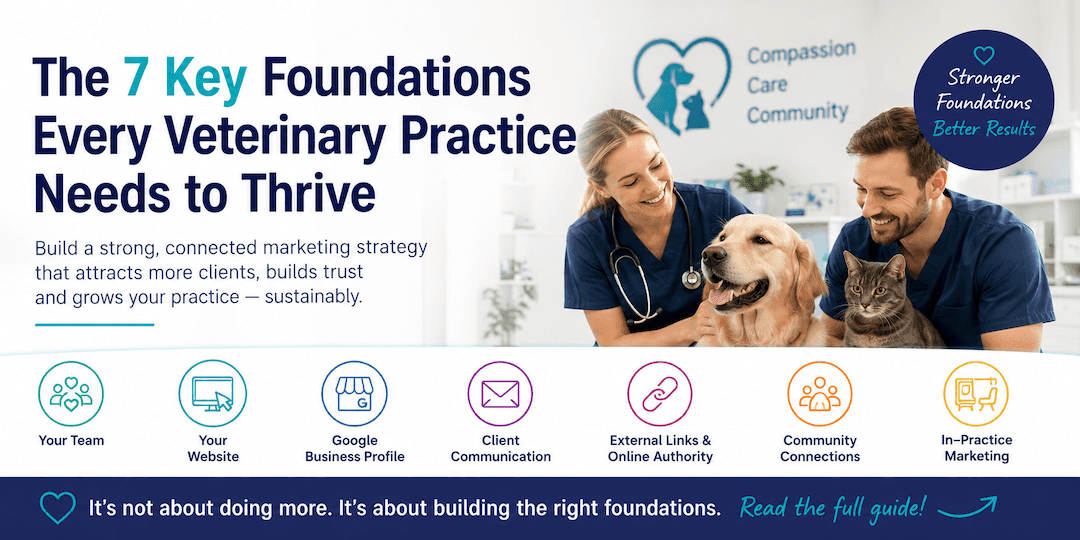
Before deciding what else your practice should be doing, assess the seven foundations that influence your results. When these foundations are connected, you can leverage the work you are already doing, improve its impact and achieve better results from every marketing effort.
What Is Veterinary Practice Marketing?
Veterinary practice marketing is the coordinated process of building awareness, attracting suitable new clients, strengthening relationships with existing clients and communicating the value of a veterinary practice across every stage of the client journey. It includes the team and client experience, website, local search presence, client communication, online authority, community involvement and marketing within the practice.
Why Veterinary Marketing Matters More Than Ever
The veterinary market has changed.
In many areas, competition between veterinary practices has increased. Pet owners have more choice, access to more information and more ways to compare practices before deciding where to take their pets.
They may:
- Ask friends or family for recommendations
- Search Google
- Explore practices through Google Maps
- Read online reviews
- Compare several veterinary websites
- Visit social media pages
- Ask an AI-powered platform for advice
Before someone calls or books, they may have already formed an impression of your practice based entirely on what they can find online.
At the same time, Google is continually changing how it displays and recommends businesses, while AI-powered search is changing how people ask questions and discover services.
Search platforms are looking beyond a few keywords on a website. They are trying to understand which businesses demonstrate genuine experience, expertise, relevance, authority and trust.
This means veterinary practices need a stronger and more complete digital presence than they may have needed in the past.
Simply having these marketing assets is no longer enough:
- A website will not perform at its best if it is outdated, contains limited information or does not reflect the quality of your practice.
- A Google Business Profile will not reach its full potential if it is incomplete, has few recent reviews or receives little ongoing attention.
- Social media will have limited impact if posts reach only a small percentage of existing followers and are disconnected from your website, Google presence, client communication and wider marketing strategy.
Each part needs to be actively maintained and connected to the others.
Marketing Is Also About Retaining the Clients You Already Have
Marketing is not only about attracting new clients.
As household budgets become tighter and pet owners have more choice, veterinary practices need to remain visible, relevant and connected between visits.
Regular communication, helpful education and a consistently positive client experience can strengthen loyalty and remind clients of the ongoing value your team provides.
Your marketing may encourage a pet owner to choose your practice for the first time, but your team, communication and client experience will influence whether they return and recommend you to others.
Standing Still Can Mean Falling Behind
The gap between veterinary practices that actively invest in their marketing foundations and those that do very little is becoming wider.
If your practice continues using the same marketing approach year after year while nearby competitors improve their websites, collect regular reviews, publish useful content, strengthen community relationships and increase their visibility across Google and AI-powered search, standing still may gradually mean falling behind.
This does not mean every veterinary practice needs to spend more money, advertise everywhere or constantly create new content.
It means marketing should be considered an important and ongoing part of operating a successful veterinary business, rather than something addressed only when appointment numbers decline or a team member happens to have some spare time.
The strongest results come from building solid foundations and connecting your activities so that each one supports the others.
Think of your marketing like a building. If you focus all your attention on one pillar while neglecting the others, the structure becomes unstable. You may attract attention temporarily, but you are unlikely to achieve consistent, sustainable growth.
The seven foundations in this guide work together to help your veterinary practice:
- Attract more of the right clients
- Convert more enquiries into appointments
- Retain and strengthen relationships with existing clients
- Encourage recommendations and positive reviews
- Build trust within your local community
- Improve visibility across Google, Google Maps and AI-powered search
- Achieve stronger and more sustainable marketing results
You do not need to do everything at once.
However, you do need to understand each foundation, identify where the gaps are and continue strengthening them over time.
Take the free 5-minute assessment and discover where your veterinary practice is strong, where the gaps are, and what you should focus on next. Plot your results on your own Marketing Foundations Wheel for an instant visual snapshot. Be honest with your answers to get the best result
The Veterinary Practice Marketing Foundations Framework, developed by Vet Marketing Services
At Vet Marketing Services, we developed the Veterinary Practice Marketing Foundations Framework to help veterinary practices understand the essential areas that work together to improve visibility, strengthen client relationships and support sustainable growth - in order of importance.
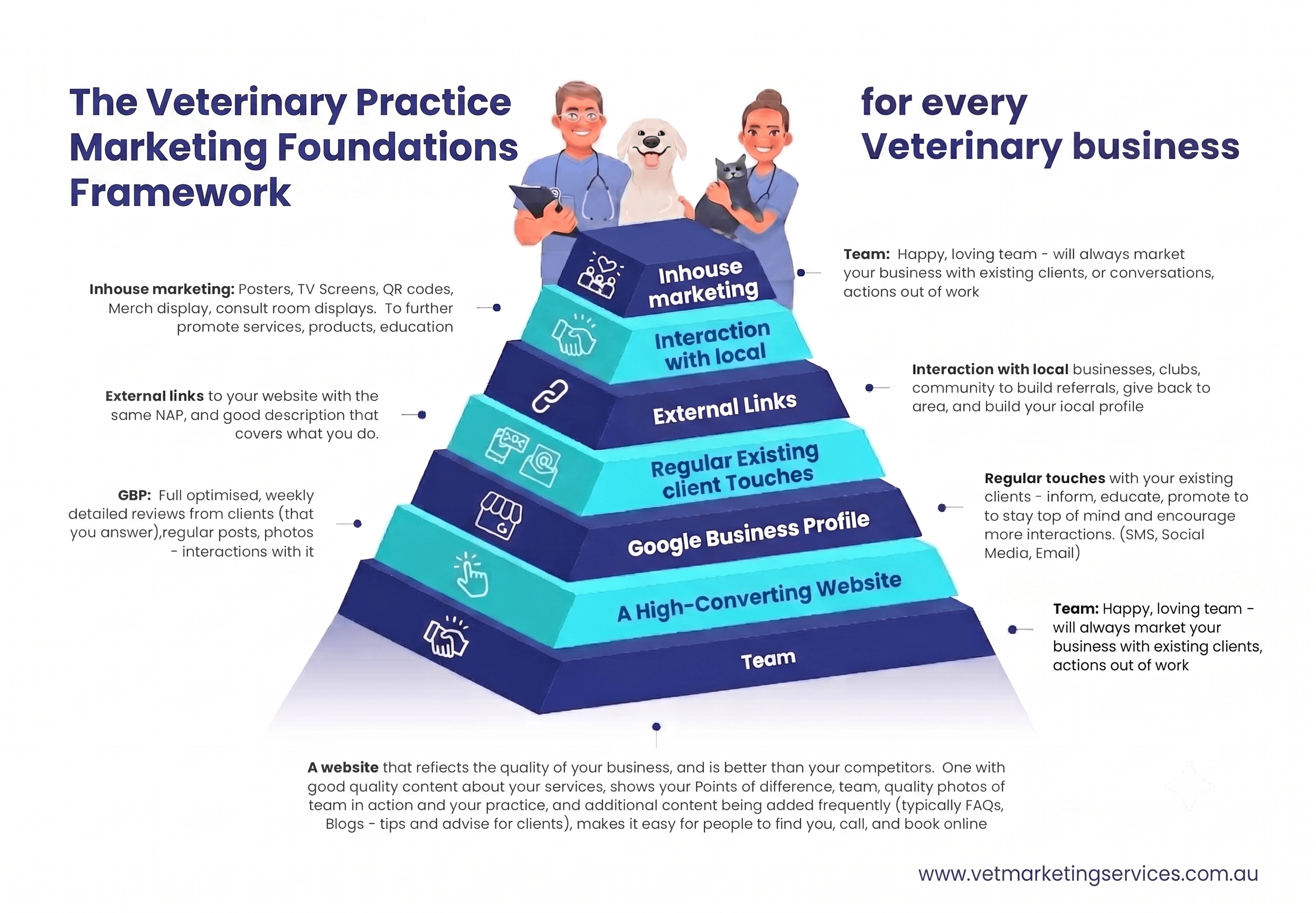
The Veterinary Practice Marketing Foundations Framework identifies seven connected areas that support effective and sustainable veterinary practice marketing. While each foundation has value individually, the strongest results occur when they work together as part of a coordinated strategy.
The 7 Veterinary Practice Marketing Foundations
A Happy, Engaged Team
Creates a welcoming and positive client experience that encourages loyalty, recommendations and positive reviews.A High-Converting Veterinary Website
Communicates your value, showcases your team and services, and truly reflects how you want your practice to be seen. It should be a website you are proud of while also supporting your visibility across Google and AI-powered search.A Fully Optimised Google Business Profile
Helps local pet owners discover, assess and contact your practice through Google Search and Google Maps.Regular Communication With Existing Clients
Strengthens client relationships, improves retention, encourages regular consultations and keeps your practice familiar and connected between visits.Relevant External Links
Build online authority, strengthen connections with trusted industry and local organisations, extend your reach, and provide valuable credibility signals to Google and AI-powered search platforms.Interaction With Your Local Community
Builds awareness, raises your practice profile, and develops familiarity and trust with local pet owners.Effective In-Practice Marketing
Uses your reception areas, consulting rooms and other client touchpoints to educate clients about available services and care options, encourage conversations, support relevant purchases and generate valuable client reviews.
Here is the Vet marketing Framework infographic to download and use.
Now in more detail...
Foundation 1: A Happy, Engaged Team
Every successful veterinary marketing strategy starts with your team.
You can have an impressive website, excellent Google visibility, strong reviews, effective advertising driving new leads and engaging social media content. However, if a potential client calls your practice and is greeted by someone who sounds unhappy, rushed, or disinterested, much of that marketing effort can be undone within seconds.
The same applies when clients arrive at the practice.
Are they welcomed warmly? Do they feel acknowledged? Are their concerns listened to? Does the team communicate clearly? Is their pet treated with genuine care and affection?
Marketing may encourage someone to contact your practice for the first time, but the experience delivered by your team determines whether that client returns, recommends you to others and becomes a long-term advocate for your business.
Your team also markets your practice outside the clinic, often without realising it.
The way they speak about their workplace to family, friends and members of the local community influences how people perceive the business. A happy team that feels supported, valued and proud of the practice naturally becomes one of its strongest marketing assets.
Before asking how you can attract more clients, ask whether you are creating an experience that makes clients and team members want to stay.
A positive culture is not separate from marketing. It is the foundation of it.
Foundation 2: A High-Converting Veterinary Website
Your website is the digital window into your veterinary practice.
When someone is referred to you by a friend, neighbour, breeder, trainer or another pet owner, there is a strong chance they will visit your website before contacting you.
They may also discover your practice through Google Search, Google Maps or an AI-powered search platform and then use your website to decide whether you feel like the right veterinary team for them.
Your website needs to do more than look attractive. It should clearly communicate:
- Who you are
- Where you are located
- The services you provide
- The types of animals you treat
- What makes your practice different
- Who your team members are
- How clients can contact you or book
- What someone can expect when visiting your practice
The design, wording and photography should reflect the professionalism and quality of your business.
Genuine photographs of your veterinarians, nurses, reception team, patients and facilities are particularly important. People want to see who will be caring for their pets. Great photography can communicate warmth, trust and personality far more effectively than generic stock images.
Your website also needs detailed and useful content about your services.
If you offer dentistry, surgery, senior pet care, behavioural consultations, diagnostic imaging, puppy and kitten care, rehabilitation or treatment for particular species, each of these services should be clearly explained.
This content helps potential clients understand what you do. It also helps search engines and AI platforms understand your expertise and determine when your practice may be relevant to someone’s search.
Behind the scenes, the website must also be technically well structured. It needs to be easy to navigate, mobile-friendly, fast, secure and set up so search platforms can find, interpret and rank its content.
A good veterinary website should make it easy for someone to:
- Find the information they need
- Understand why they should choose you
- Call the practice
- Request an appointment
- Book online
- Find your location
You also need to keep improving it.
Adding FAQs, educational articles, client resources, service information, team updates and useful advice gives both clients and search platforms more reasons to return.
When a potential client compares your website with those of nearby veterinary practices, does yours give them the confidence and connection they need to choose you?
Foundation 3: A Fully Optimised Google Business Profile
For many veterinary practices, the Google Business Profile is one of the most important sources of new client enquiries.
Pet owners may search for:
- Vet near me
- Veterinarian near me
- Vet open today
- Emergency vet
- Puppy vaccinations
- Cat vaccinations
- Dog dentist
- Local veterinary clinic
Many people also bypass a traditional search and go directly to Google Maps.
They compare practices based on location, opening hours, photos, reviews, services and how professional and active each profile appears.
Simply having a Google Business Profile is not enough. It needs to be complete, accurate, optimised and regularly maintained.
This includes:
- Selecting the correct primary and secondary categories
- Adding all relevant veterinary services
- Maintaining accurate opening and holiday hours
- Including current phone, website and booking information
- Uploading genuine, high-quality photos
- Publishing regular posts and updates
- Encouraging a consistent flow of client reviews
- Responding thoughtfully to reviews
- Keeping all practice information accurate and consistent
Reviews are particularly influential.
Potential clients look at the overall rating, the number of reviews, how recent they are and what people say about the team and client experience. They also notice whether the practice responds.
A thoughtful response demonstrates that your practice listens, cares and values feedback.
Your Google Business Profile should not be treated as something that was set up several years ago and then forgotten. It is a living part of your digital presence and needs ongoing attention.
When managed well, it can help your veterinary practice stand out when local pet owners are actively looking for care.
Foundation 4: Regular Communication With Existing Clients
Attracting new clients is important, but retaining your existing clients is equally valuable.
Your current clients already know your practice. They have trusted your team with their pets and, when they have a positive experience, they are more likely to return, use additional services and recommend you to others.
However, you cannot rely on clients remembering everything their pet may need.
Where appropriate, encourage clients to book their next recommended appointment before leaving the practice. This may include their next health check, vaccination, dental review, progress examination or ongoing treatment appointment.
Between visits, continue providing helpful information through a combination of:
- Email newsletters
- SMS reminders
- Preventative health communications
- Educational articles
- Social media
- Seasonal advice
- Practice updates
- Team and community news
Not every client uses the same communication channel.
Some follow your practice closely on Facebook or Instagram. Others rarely use social media but regularly read their emails. Some are most likely to respond to an SMS.
This is why relying on social media alone creates gaps.
Email is often underestimated by veterinary practices. We regularly see veterinary businesses achieve strong email open rates because pet owners genuinely want trusted information about the health and wellbeing of their animals.
“We regularly see veterinary practices achieve strong email engagement (above other industries) when they consistently provide useful, seasonal pet care advice rather than communicating only when promoting an offer.”
You do not need to email clients every week. A useful monthly email, or even one sent every couple of months, can keep your practice familiar and relevant.
The goal is not to continually promote or sell. It is to inform, educate and remain connected.
When clients regularly receive valuable advice from your practice, you are more likely to remain their trusted source when their pet needs care.
Foundation 5: Relevant External Links
External links are links from other websites back to your veterinary practice website.
They are valuable because they help people discover your practice and can strengthen your online authority.
Search engines and AI-powered platforms look at the information on your website, but they may also consider which other reputable organisations mention or reference your business.
Useful external links may come from:
- Veterinary and industry directories
- Local business directories
- Professional associations
- Community organisations
- Sporting clubs
- Schools and educational institutions
- Animal welfare organisations
- Local media
- Events you support
- Research papers or professional articles written by your team
The quality and relevance of these links matter more than simply collecting a large number of them.
A link from a respected veterinary association, local community organisation or relevant publication is generally more useful than a link from a random website with no connection to your practice.
Your business information should also be consistent across reputable directories.
Your practice name, address and phone number should match the details displayed on your website and Google Business Profile. This is often referred to as your NAP information, meaning name, address and phone number.
Your own channels should also link people back to your website.
Google Business Profile posts, social media posts and email newsletters should regularly direct people to relevant service pages, articles and booking information.
This helps move people from a brief piece of content to more detailed information on a platform your practice controls.
Foundation 6: Interaction With Your Local Community
Veterinary practices are local businesses built on relationships, familiarity and trust.
Being visible and involved within your community can create connections that online promotion alone may struggle to achieve.
Community interaction may include:
- Supporting local sporting clubs
- Working with rescue groups and animal welfare organisations
- Attending community events
- Supporting schools and educational programs
- Hosting information evenings
- Providing general pet care education
- Participating in local business groups
- Sponsoring local activities
- Offering practice tours
- Supporting charities and community initiatives
One veterinary practice owner we know used a very simple but effective approach when launching his business.
He took his dog, a chair and a pull-up banner to a local shopping centre. The banner invited people to ask him general questions about their pets.
He was not conducting examinations or providing formal consultations. He simply made himself available to meet local pet owners, answer questions and become known within the area.
For a new practice, it was an excellent way to build awareness, familiarity and trust.
Community involvement does not always need to involve large sponsorships or expensive events. Sometimes being present, approachable and genuinely helpful creates the strongest results.
Where possible, extend the value of these activities online.
Share them through your website, Google Business Profile, email newsletter and social media. Ask the clubs, charities and organisations you support to acknowledge your involvement and link to your website.
One community activity can then help generate:
- Local awareness
- Social media content
- Website content
- External links
- Google Business Profile updates
- Client goodwill
- Future referrals
This is a good example of how one marketing effort can support several different foundations.
Foundation 7: In-House Marketing
Your marketing should not stop once a client walks through the door.
The consulting rooms, reception area, waiting room and retail spaces all provide valuable opportunities to educate clients and promote the services available within your practice.
Consider what clients see while waiting.
Are your posters current and professionally presented? Is your merchandise displayed clearly? Are you highlighting services clients may not realise you offer?
Many clients know their veterinary practice provides consultations, vaccinations and surgery. They may not know that you also provide:
- Dental care
- Senior pet assessments
- Behaviour consultations
- Weight management
- Puppy and kitten programs
- Diagnostic imaging
- Rehabilitation
- Nutrition advice
- Nurse clinics
- Preventative health plans
Posters and consultation-room displays can help begin these conversations.
Digital screens are another valuable option. Rather than showing the same generic content repeatedly, they can feature:
- Team introductions
- Patient stories
- Veterinary services
- Seasonal health advice
- Client testimonials
- Community activities
- Preventative health information
- Behind-the-scenes practice content
- Educational videos
QR codes can make it easier for clients to take the next step.
A client could scan a QR code to:
- Read more about a service
- Book an appointment
- Visit a relevant website page
- Download a pet care guide
- Follow your social media
- Join your email list
- Leave a Google review
The same thinking can be applied inside consulting rooms.
Relevant information about dental care, weight management, parasite prevention, senior pet care or other services can support the conversations your veterinarians and nurses are already having.
This is not about turning your team into salespeople.
It is about helping clients understand the care options available to their pets and making useful information easy to access.
Good in-house marketing is simply an extension of good client education.
Where Does Social Media Fit?
Social media remains a valuable part of veterinary marketing, but it should support the seven foundations rather than replace them.
It can help your practice:
- Showcase your team and culture
- Share useful pet care advice
- Celebrate patients
- Promote website articles
- Explain your services
- Highlight community involvement
- Build relationships with clients
- Encourage comments and sharing
- Keep your practice familiar
However, posting regularly does not automatically mean you are reaching large numbers of potential new clients.
Organic posts may only be shown to a portion of your existing audience unless people actively engage with them. This is why posts should invite interaction where appropriate.
Ask questions. Encourage people to comment. Invite clients to share pet photos. Create useful advice that people want to save or send to someone else. Respond to comments and involve the team in the conversation.
Social media works best when it is connected to the rest of your marketing.
A social post can lead to an article on your website. An email can promote that same article. The article can be shared through your Google Business Profile. A poster in reception can include a QR code linking to it. Your team can use the information when speaking with clients.
Instead of creating five unrelated pieces of marketing, you have created one strong piece of content and used it in five different ways.
It May Sound Like a Lot, But You Can Work Smarter
When you look at all seven marketing foundations together, it can initially feel like there is a lot to manage.
The truth is, there is probably more involved in effective veterinary marketing than many practices first realise.
However, that does not mean every activity needs to be created from scratch.
One well-planned piece of content can often be adapted across multiple channels.
For example, an article about senior pet care could become:
- A detailed website article
- A shorter email newsletter feature
- Several social media posts
- A Google Business Profile post
- A waiting-room screen
- A consulting-room poster
- A downloadable checklist
- A script for a short video
- A team discussion guide
This is how smaller veterinary teams can market more consistently without continually adding to their workload.
Through the growing library of resources on the Vet Marketing Services website, you will find practical ideas and advice to help you make better use of your content, strengthen each foundation and get more value from the marketing work you are already doing.
Strong Marketing Comes From Covering Every Foundation
No single marketing activity will carry your veterinary practice forever.
A social media campaign cannot compensate for an outdated website. A beautiful website cannot overcome a poor client experience. Great reviews will not help as much as they should if your Google Business Profile is incomplete. Regular emails will not retain clients if the care and communication inside the practice are inconsistent.
Each part supports the others.
- Your team creates the experience.
- Your website communicates your value.
- Your Google Business Profile helps local pet owners find you.
- Regular communication strengthens client relationships.
- External links build visibility and authority.
- Community involvement develops trust and recognition.
- In-house marketing educates clients and helps them understand the full range of care available.
When these foundations are working together, social media, SEO, Google Ads and other promotional campaigns become far more effective.
Marketing helps people discover your veterinary practice. Your team, reputation, expertise and client experience give them a reason to choose you and continue returning.
Need Help Strengthening Your Veterinary Marketing Foundations?
You do not need to tackle every area at once, but you do need to understand which foundations are already strong and which ones require attention.
The Vet Marketing Services team can help you review your current marketing, identify the highest-priority opportunities and put the right foundations in place.
Where possible, we can also take care of selected marketing activities for you, helping your practice achieve more without adding further pressure to an already busy team.
We are a talented group of marketing specialists who are genuinely passionate about the veterinary industry and love helping practices achieve meaningful results.
Contact our Vet Marketing Services team to discuss how we can help strengthen your marketing foundations and support the future growth of your practice.
| Tags:AttractConvertDigital Marketing for Vets |



)